
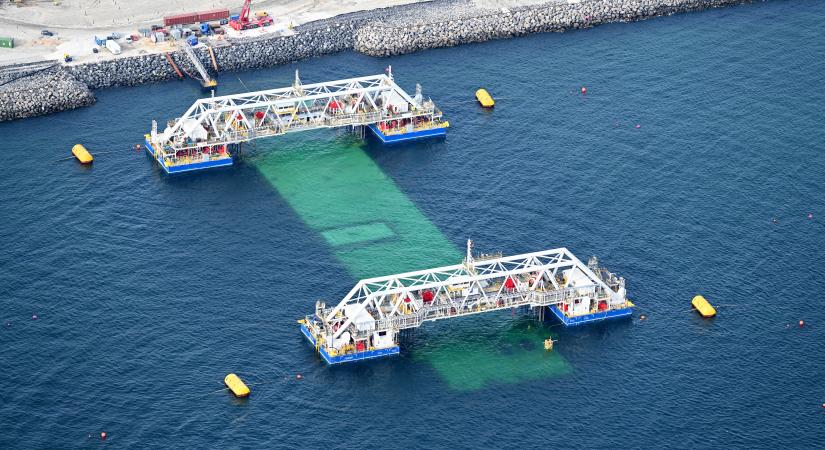
On Wednesday, 6 May, the first of 89 concrete elements for the Fehmarnbelt tunnel was placed in the dredged trench on the seabed off Rødbyhavn following an operation lasting several days.
The historic operation began on the evening of 4 May, when five tugboats and a specially designed immersion vessel transported the tunnel element from the factory near Rødbyhavn to the immersion site close to the future tunnel entrance.
At 12 noon on Tuesday, 5 May, the immersion operation itself began, and just over 14 hours later the first tunnel element had been positioned precisely in the tunnel trench in front of the tunnel portal at Rødbyhavn, according to Sund & Bælt.
Work then began to connect the element to the portal using a hydraulic arm. The final position of the element was confirmed through a precise laser measurement carried out through the tunnel. By Thursday morning, the first tunnel element was officially in place on the seabed.
A Crucial Test
The next step for the contractors is to disconnect the immersion vessel IVY and secure the element on the seabed by adding gravel and stone ballast along the sides to ensure that the element cannot move within the tunnel trench.
“We are both happy and relieved. Our technology, our equipment and our contractors have passed a crucial test and achieved something that has never been done before. This is a very important day for the project, for Denmark and Germany, and for Europe,” said Sund & Bælt CEO Mikkel Hemmingsen after the successful operation.
In the coming years, the tunnel elements will be immersed one by one and connected in a dredged trench on the seabed up to 40 metres below sea level. At 18 kilometres in length, the Fehmarnbelt tunnel will by far become the world’s longest immersed tunnel.
Important for Europe
The Fehmarnbelt link is an important part of Europe’s future transport network, designed to strengthen trade, mobility and security across Europe. The Fehmarnbelt tunnel has been designated a priority project by the European Commission, which has granted more than DKK 10 billion in construction support.
“The immersion of the first tunnel element is a historic achievement. The world is watching, and you are demonstrating European engineering and construction at its very best. The tunnel will bring regions closer together and create new momentum between Malmö, Copenhagen, Hamburg and the rest of Europe. The European Commission will continue to support this project all the way,” said EU Transport Commissioner Apostolos Tzitzikostas.