
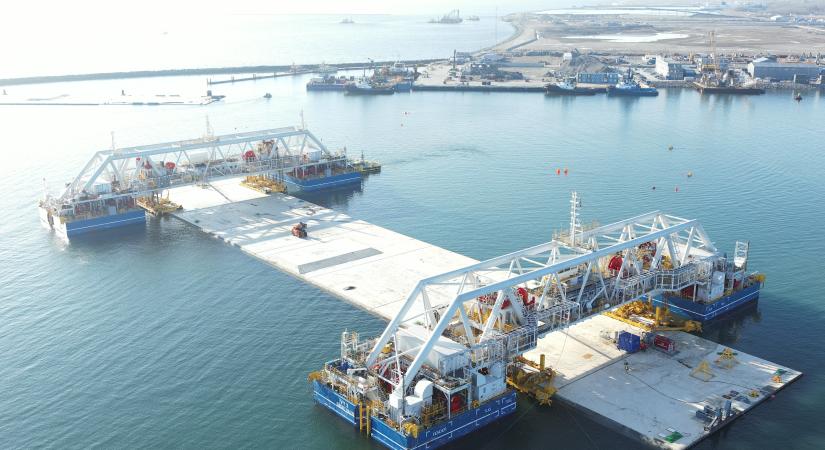
Monday, 4th May marked the day when the first of 89 concrete elements that will form the future Fehmarnbelt tunnel between Denmark and Germany was towed out to the immersion site, off the coast of Rødbyhavn on Lolland.
The 217-metre-long and 73,500-tonne concrete element left the tunnel factory’s work harbour at 21:00 and began the journey of just over two kilometres to the immersion site near the future tunnel entrance.
The tunnel element consists of the four tubes that will carry the future motorway and railway, as well as a service tube for technical installations.
A complex operation
The tunnel element was transported using five tugboats and a specialised vessel built to immerse the element on the seabed.
The element is sealed at both ends and filled with air. However, as the road tubes are heavier than the railway tubes, the element is not naturally balanced. Therefore, the outer railway tube is equipped with temporary water ballast tanks to ensure that the element remains completely horizontal during immersion.
“This is a highly complex operation that has never been carried out on this scale before. The Fehmarnbelt tunnel elements are wider, heavier and longer than those used to build the Øresund link, and we will be working in significantly deeper water,” explains Lasse Vester, Deputy Contract Director at Sund & Bælt.
Very small margin for error
The tunnel element will be placed in an 18-kilometre-long trench in the seabed between Rødbyhavn and Puttgarden. Before immersion, a layer of gravel has been laid in the trench to ensure the element is positioned correctly.
“This is a major task with a very small margin for error. We need to immerse an element as long as two football pitches within just a few millimetres. This places high demands on the equipment and our contractor, which is why preparations have been underway for a long time,” says Lasse Vester.
The transport of the element and the immersion itself is expected to take several days. Once the element is connected to the tunnel portal, the next step is to place gravel and stones along the sides of the element to secure it in the trench.